

ESSA KHAN TO ISA KHEL

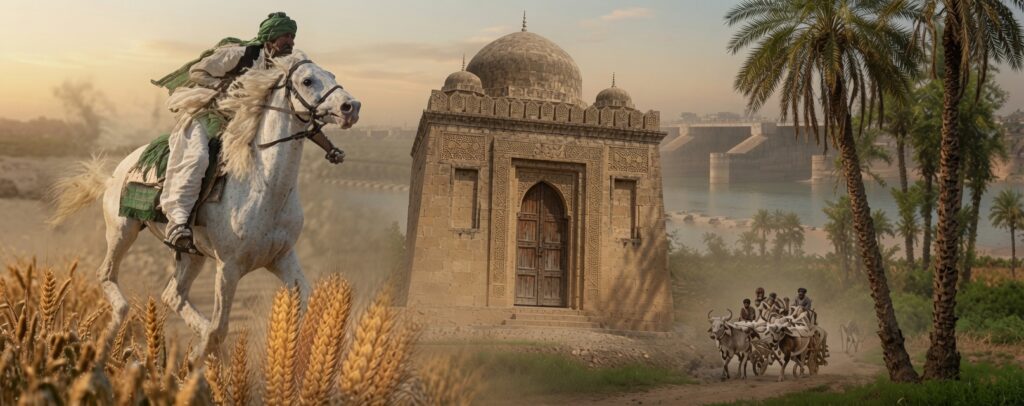
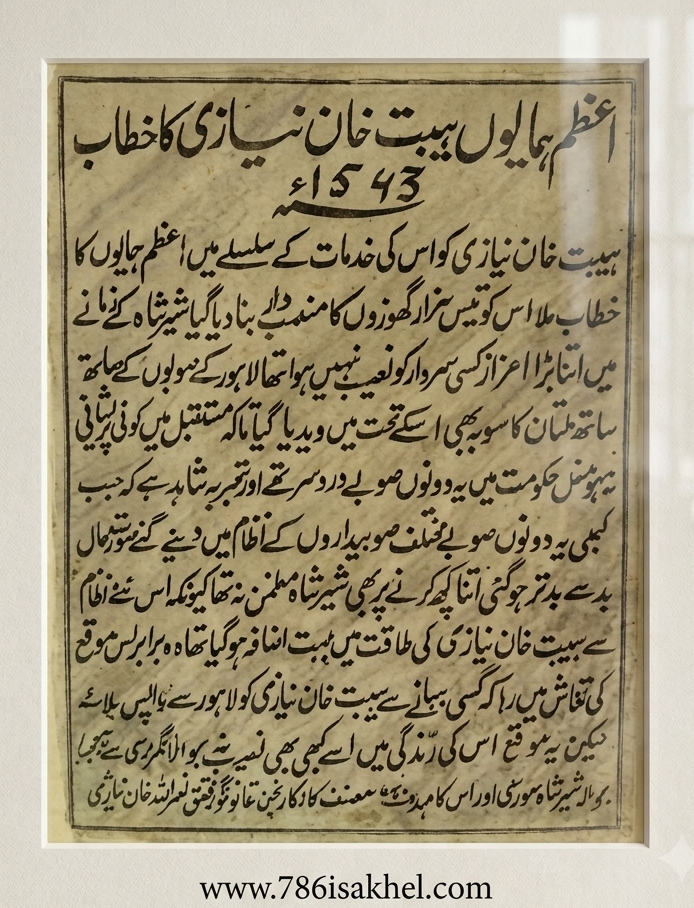
 From history ref Essa khan was born in 1453 and his brother would have born be born in b/w 25 years, his last brother was born in 1478. Essa khan died in 1548 at the age of 95 in delhi. The period of 1451 – 1525 was the golden period of khan’s Niazi because in that period Lodhi’s were completely dominated on subcontinent (hindustan). Sikandar lohdhi and ebraheem Lodhi families, sher shah souri and Niazi families are of one unit. The large part of the sir umer khan family was attached with Essa khan Shahi darbar but umer khan permanently settled in Dehli and all of his five brothers lived with him and deputed Delhi dUrbar and current govt. Affairs. In the honor of great war of Haybat khan sher shah suri awarded him a title Azam – e – Hyumayoo and also made him governor of multan and send him to Multan in area Pergani kuchi (present Mianwali) there were great confusion build up between Haybat khan Niazi (father genealogy of habit is given Bhumbra’s genealogy) and sher shah soori and this confusion ended with mutiny
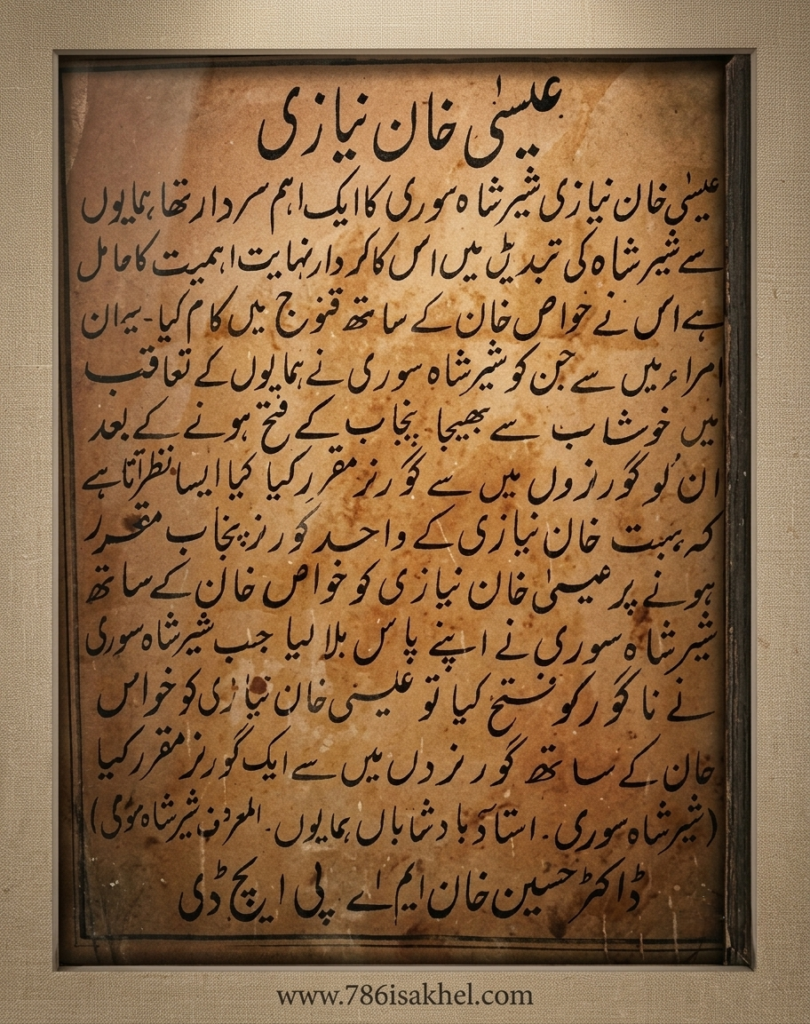
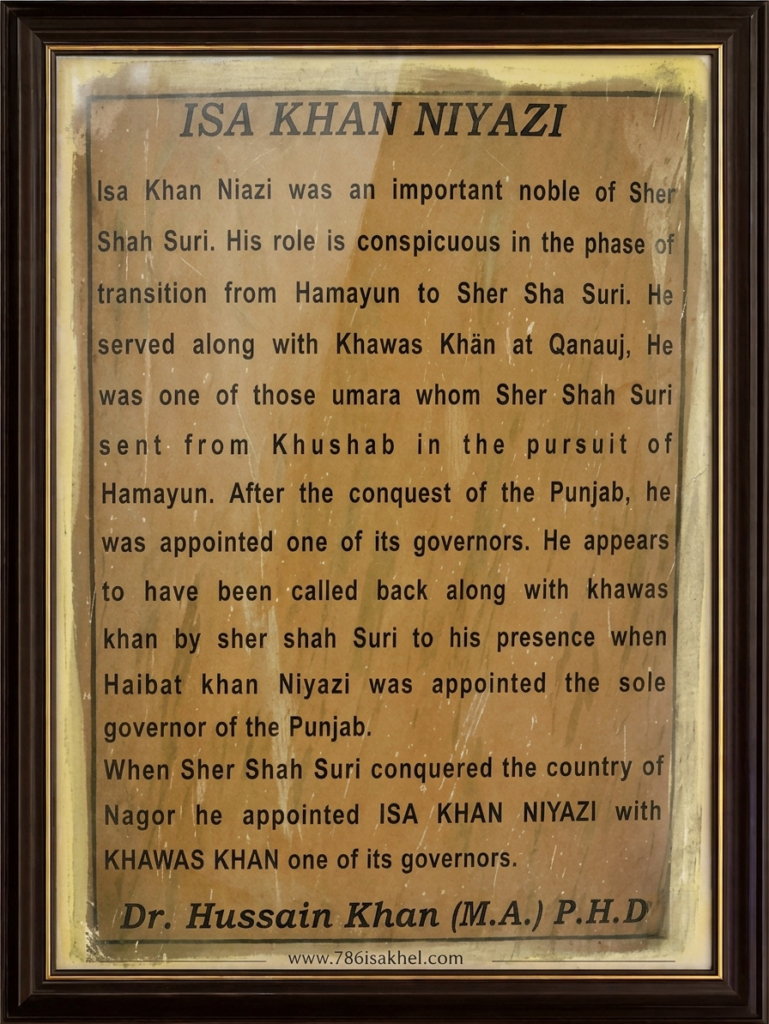

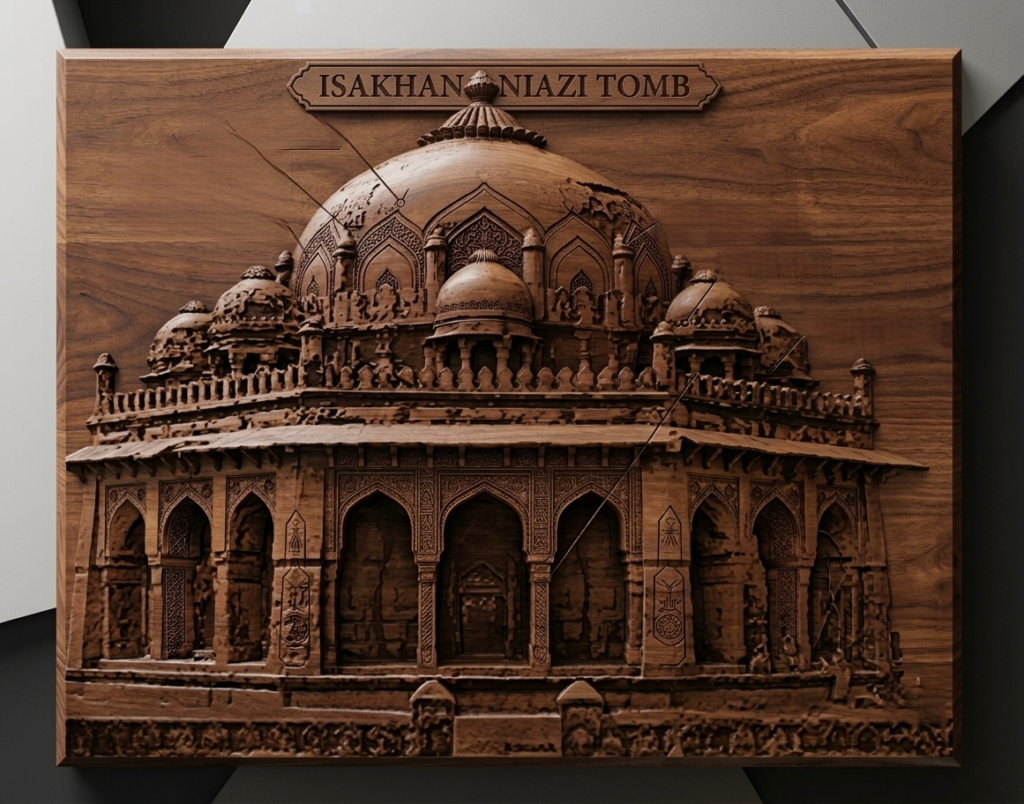
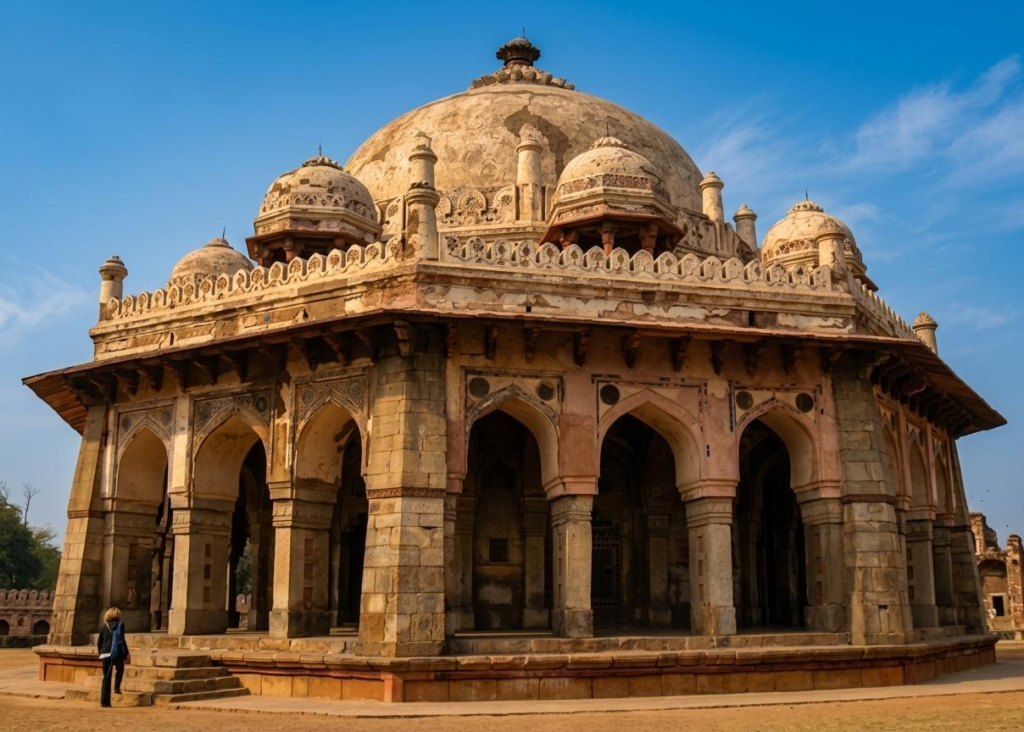
Isa khan’s tomb is situated just outside the Humayun’s tomb precincts in new Delhi. It was built in the honor of Essa khan, a brave and valiant noble under sher shah, the Afghan ruler who had overthrown Humayun it was built in 1547, in an octagonal pattern. It is an architectural gem in the Islamic art in India and remained a model tomb amongst the ruling families in its time. Said to be inspired by the tomb of Siyanda Lodhi
The town was founded about 1830 by Ahmad khan, ancestor of the present khans of Isa khel, who are the acknowledged heads of the trans-Indus Niazi; and it takes its name from shah Isa khel, a religious teacher, whose descendants still live in the town. The Isa khel is also famous for the feudal Niazi chiefs who were designated nawabs during the British colonial era some of them got the title of khan bahader “during that period. Isa khel remains the first Niazi stronghold in the district after they left the Marat plains.Isa khel, inhabitants were hindus and that before the christian era the town formed an integral portion of the graeco-bactrian empire of Kabul and the Punjab. The Isa khel has been settled of Pathans from the Khyber Pakhtunkhwa . Mahmoud of Ghazni is said to have ravaged the upper half of the district together with bannu, expelling its hindu inhabitants and reducing the country to a desert the series of afghan immigrations into Bannu took place and the bannuchis, the marwat and the Niazis settled in the fertile portion of the country on either bank of the kurram. Towards the close of the fifteenth century they spread north into the plain now known as marwat and squatted there as graziers, and perhaps too as cultivators (on the banks of the kurram and gambila) there they lived in peace for about fifty years, till the time Marwat Lohdis, a younger branch of the lodhi group, swarmed into the country the defeated them in battle, and drove them across the kurram at Darra Tang  , in the valley beyond which they found a final home the most important sections of the expelled Niazis were the Isa khel. Mushanis and a portion of the sarhangs the first named took root in the south of their new country and shortly developed into agriculturists the emperor akbar presented Isa khel in jagir to two of their chiefs. During the civil commotions of the jahangir’s regime, the Niazis are said to have driven the ghakkars across the salt range, and though in the following reign, the latter recovered their position, still their hold on the country was precarious, and came to an end about the middle of the 18th century as stated above in 1748.A durrani army under one of ahmad shah’s generals crossed the indus at kalabagh,and drove out the ghakkars, who are still ruling in the cis – indus tracts of the district, owing nominal allegiance to the emperor at delhi. Their stronghold, on muazzam nagar, was raised to the ground and with their expulsion was swept away the last vestige of authority of the mughal emperor in these parts. No sooner had the insatiable ranjit singh gained the indus for a frontier than he determined to advance it to the suleiman range itself in 1823 he crossed the indus at the head of a large force, marched through Isa khel and Marwat without opposition, and pushed on to the outskirts of bannu. But after staying a month or two, he retired without attempting to plant a garrison in the trans-indus country. On 29th march 1849 the punjab was annexed, and the territories, now comprised in the mianwali district, became formally a portion of british india. Isa khel municipality was created in 1875 on the separation the n.w.f.p. from the punjab a further reconstitution took place, and on 9th november 1901 the mianwali district formed out of the four tehsils of Isa khel, mianwali, bhakkar and leiah, the two former being taken from bannu, and the two latter from dera ismail khan district. The Isa khel tehsil was initially part of bannu and Isa khel became tehsil lying on the west bank of the indus, this tehsil is cut off from the rest of the district, and would seem to belong more properly to the n.w.f.p. but is separated even more completely from bannu by the semicircular fringe of the chichali and maidani hills, which leave it open only on the river side. These hills drain into Isa khel and make it fertile .
ISA KHEL WAS KASBA
FIRST BIRTH ENTRY IN ISA KHEL

As per birth register record of 1876 Isa khel was known as kasba (tehsil of distict bannu) and hindus were also living there 1st birth entry is a of hindu girl who was born on 1st jan 1876 she was daughter of a shop keeper raloo nehrind her name was mst koomdan they were from rohshan khel mohalla .
SATI MONUMENT IN ISA KHEL
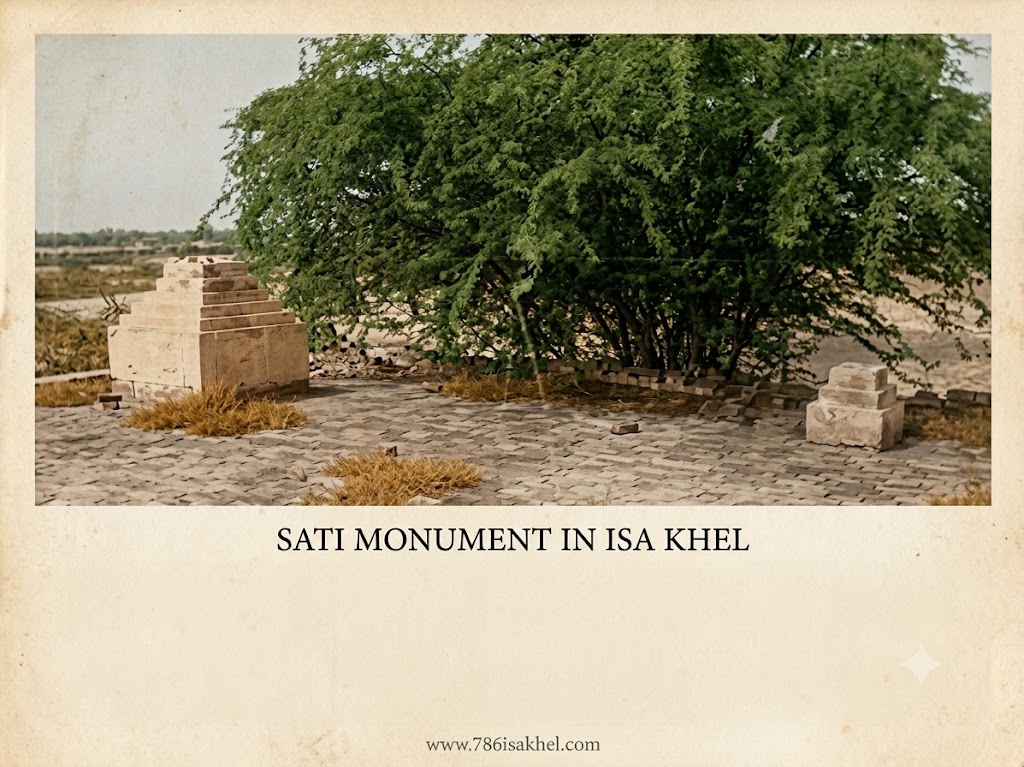 The Sati Site of Isa Khel is a historically significant location traditionally associated with the ancient Hindu practice of Sati (also known as Suttee). According to local traditions, this site in Isa Khel, Mianwali District was connected with the funeral custom in which a recently widowed Hindu woman was believed to have immolated herself on her deceased husband’s funeral pyre.
The term Sati originates from the Sanskrit word Satī (सती), meaning “a true, virtuous, or devoted woman.” The name is derived from the Hindu goddess Sati (Dakshayani), who, according to Hindu mythology, self-immolated after being unable to endure the insult and humiliation directed toward her husband, Lord Shiva, by her father, King Daksha. Over time, the name of the goddess became associated with the practice and was also used to refer to a widow who performed the act.
Historically, the practice of Sati was limited to certain regions and communities of the Indian subcontinent and was not a universal tradition among Hindus. Historical accounts indicate that while some women were described as choosing the act voluntarily, many cases involved strong social pressure, family expectations, or coercion. The practice became a subject of intense religious, social, and ethical debate among reformers and communities.
The practice was officially prohibited in 1829 during British rule through the Bengal Sati Regulation, introduced under Governor-General Lord William Bentinck. After the creation of Pakistan in 1947, such practices remained prohibited, and Sati is no longer recognized as a legal or social custom.
The presence of a Sati-associated site in Isa Khel reflects the region’s diverse historical landscape, where different religious communities, traditions, and cultures coexisted for centuries. Rather than representing a continuing religious practice, the site today holds value as a historical and cultural reference point, offering insight into the social customs and changing traditions of the past.
Preserving and documenting such locations helps future generations understand the complex history of Isa Khel and the wider Mianwali region, highlighting its multicultural heritage and the many communities that contributed to its historical identity.
ISA KHEL TOWN COMMITTEE
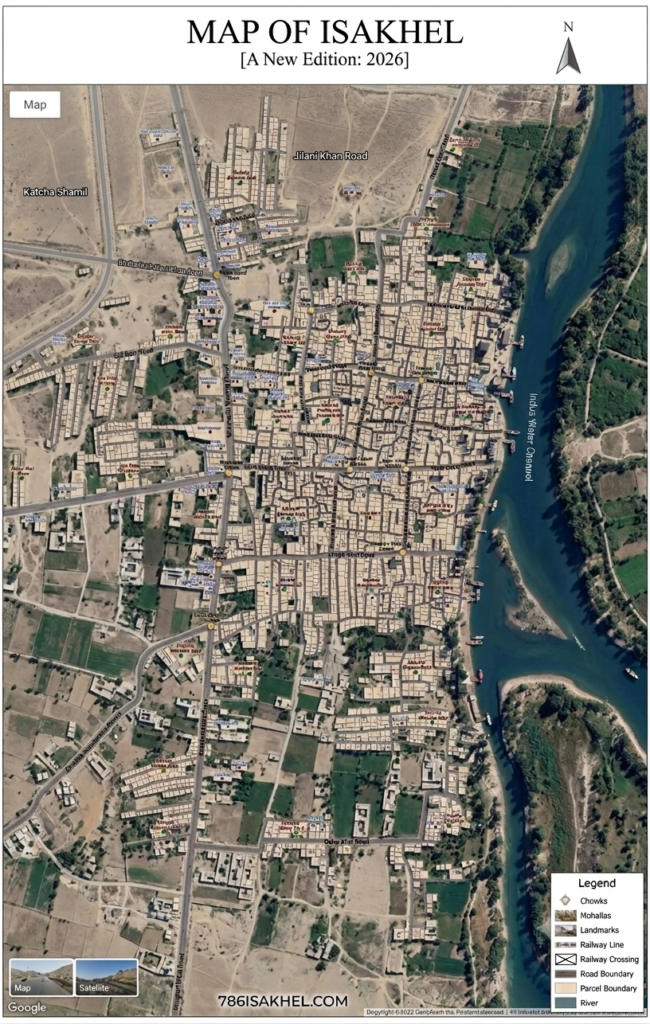
Isa Khel Town has historically been organized into several mohallas (residential quarters), each carrying the name and identity of the prominent clans, families, and communities that established their settlements in these areas. These traditional neighbourhoods represent the rich tribal, cultural, and social heritage of Isa Khel, reflecting the ancestral roots and settlement patterns of its inhabitants. The historic mohallas include Alam Khel, Bumbran Wala, Esab Khel, Muhammad Ameen Khan, Mumo Khel, Rohshan Khel, Usman Khel, Khani Khel, Mukarab Khel, Lungar Khel, Parraly Khel, Shah Isa Khel, and Azeema Abad. Together, these localities preserve the historical identity of Isa Khel and serve as a living record of the town’s diverse clan-based heritage and community structure.
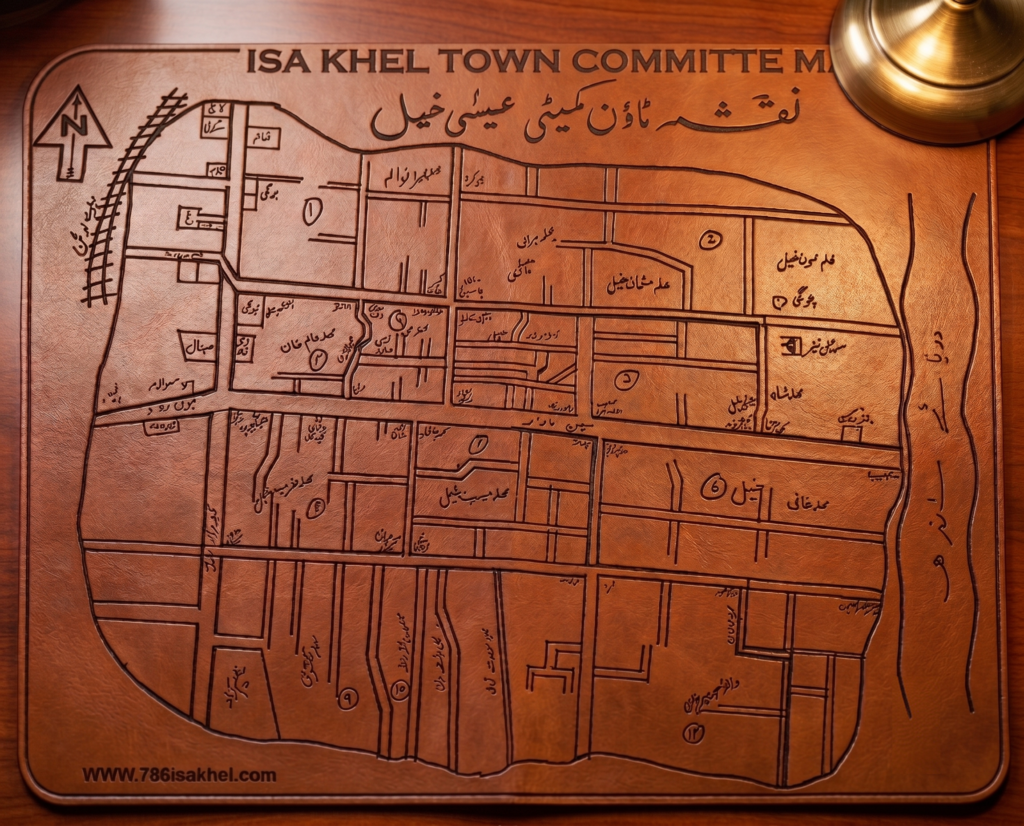
Isa khel town committee is comprises of mohallas and they are named after the major clan living in that locality ,Mohallas are Mohalla Alam Khel ,Mohalla Bumbranwala ,Mohalla Esab Khel. ,Mohalla Muhammad Ameen Khan ,Mohalla Mumo Khel ,Mohhal Rohshan Khel, Mohalla Usman Khel , Mohalla Khani Khel ,Mohalla Mukarab Khel , Mohalla Lungar Khel , Mohalla Parraly Khel , Mohalla Shah Isa Khel ,Azeema Abad .
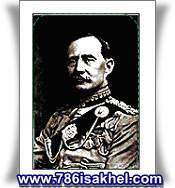

General Lionel Dunsterville’s Visit to Isa Khel (1913)
General Lionel Charles Dunsterville (1865–1946) was a British Army officer who was commissioned into the British infantry in 1884. He later served in the colonial Indian Army, taking part in military operations on the North-West Frontier, Waziristan, China, and other regions of the British Empire. He is also remembered for commanding the famous Dunsterforce during the First World War.
In his personal diaries, The Diaries of General Lionel Dunsterville 1911–1922, he recorded his Mianwali Staff Tour of November 1913, providing a valuable historical account of the region and its military importance.
19 November 1913:
Dunsterville departed for the Mianwali Staff Tour, describing the journey as difficult. He travelled via Jhelum and Lala Musa, reached Kundian at 3 a.m., rested under a tree until morning, and arrived in Mianwali at 8 a.m.
20 November 1913:
He attended the first day of the Staff Tour, which involved planning a military exercise to move a division across the River Indus in the presence of a simulated enemy force. Senior officers, including General Campbell, General Younghusband, General O’Donnell, General Miles, and General Stokes, participated in the exercise.
21 November 1913:
The actual river crossing was carried out using ferry boats. Dunsterville noted the difficulties of moving horses across the river and recorded: “Reached ISA KHEL at sunset.” He mentioned that Sir James Willcocks approved the arrangements and that General Hudson was also present.
22 November 1913:
The military exercise continued with movements through difficult terrain, including canal cuts and an attack exercise on the Dara Tang Pass.
23 November 1913:
After completing the exercises, Dunsterville left Isa Khel by the small-gauge railway at 2:30 p.m., travelled to the Indus riverbank near Kalabagh, crossed by steam ferry, and continued his journey towards Makhad Road.
24 November 1913:
He rode to Makhad with local officers, including Ali Khan and Masim Khan, where he received a warm reception. He recorded that after losing his sun helmet (topi), he wore a turban, which attracted admiration. He also visited local shrines where prayers were offered for his future promotion to the rank of General.
Dunsterville’s diary provides a rare first-hand colonial-era account of Isa Khel, documenting its strategic importance, railway connections, river crossings, local hospitality, and the military geography of the Mianwali region in the early twentieth century.
MAHARAJA KHARAK SINGH
A sikh ruler of the sovereign country of punjab and the sikh empire. He was the eldest legitimate son of ranjit singh and maharani datar kaur. He succeeded his father in june 1839.after succeession he visited BANNU and enroute he stayed night at sikhanwala kot(fort) in ISA KHEL
ISA KHEL UNION COUNCILS
Isa Khel Tehsil, head-quartered at Isa Khel , is one of the three Tehsils (sub-divisions) of Mianwali district in the Punjab province of Pakistan. Total area of the Tehsil is 675 square miles. Average area under crops in 1877 to 1 881 was 128 square miles. Total area assessed for government revenue 432,016 acres. Total revenue of the Tehsil was Rs 6361 and population of Tehsil in 1801 was 59,546 persons from following cast3,982 ; Number of towns and villages were 47 , of which 18 contained less than five hundred inhabitants. The landholders are mostly of the Niazai tribe but during their long residence in the valley of the indus, they have lost their mother tongue, Pashtu, and now use only the Punjabi dialect of their tenants. Union councils of Isa Khel Tehsil.The Tehsil of Isa Khel is administratively subdivided into 14 union councils: 14 unions are Chapri, Isakhel, Kalabagh, Kallur, Kamar Mushani, Kamar Mushani Pakka, Khaglanwala, Kot Chandna, Sultan Khel, Tabisar, Tanikhel, Tola Bhangi Khel, Trag, Vanjari .On this page detail about each has been given for the information of the visitors please . 
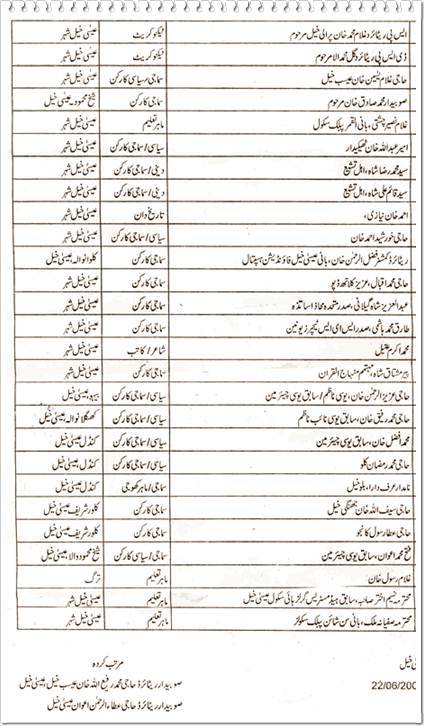
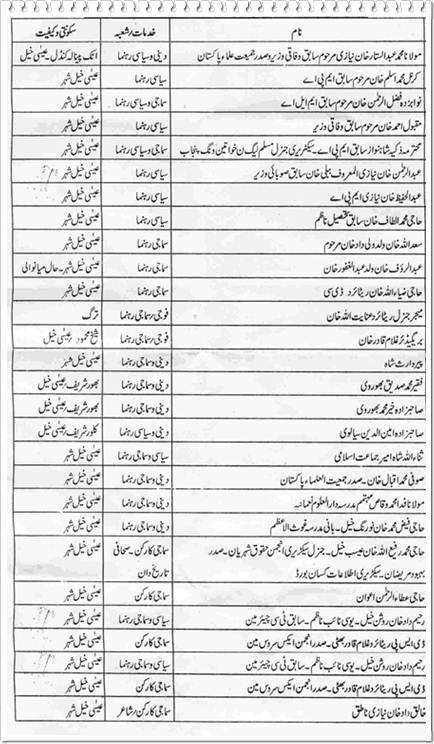
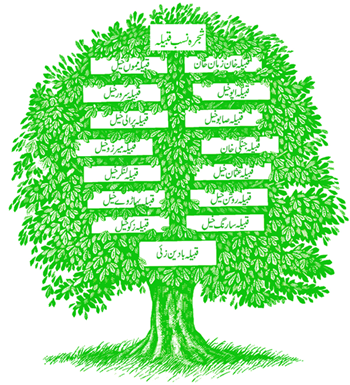 mianwali.org website is having largest online library of family trees with pictures about clans living in Isa Khel and in Isa khel unions and their historical information . We’re constantly adding more. So, there are always new discoveries waiting for you.

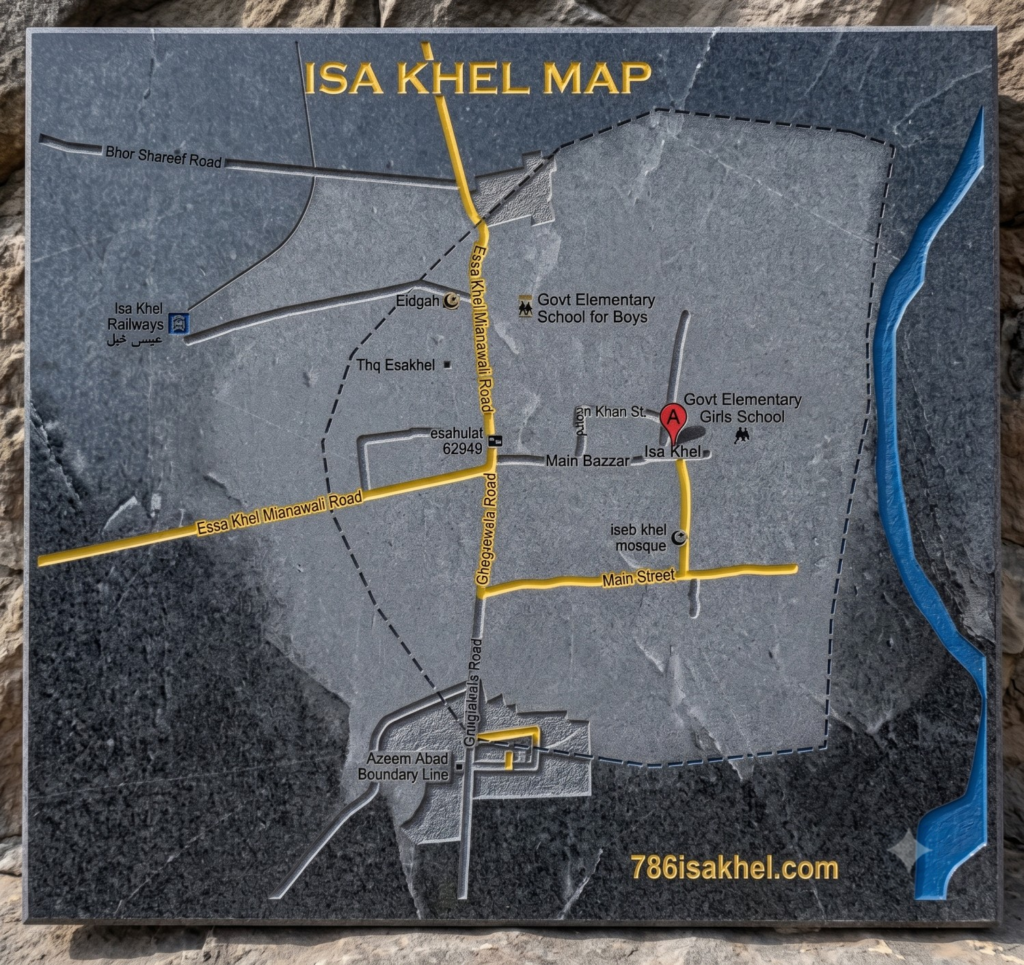
ROAD MAP
Isa Khel road map or route map attached to primarily displays roads and transport links rather than natural geographical information. It is a navigational map that commonly includes political boundaries and labels, making it also a type of political map. In addition to roads and boundaries, road maps include points of interest, such as prominent businesses or buildings, tourism sites, parks and recreational facilities, hotels and restaurants etc.






aoa most respectfully..
sir mashallah ap ne bahot achi kawish ki…
kuch thinks ap k knowledge mian azafa k liye.
muhallah jaat mian Wandhi peeran wali ka zikr nh hye..and isi muhallah mian bahadar khel qabila hye jo k ek bahot purrani history rakhta hye. aur is qabila se Late,Muhammad Saeed Khan SHO Rawalpindi ek bahot famous person guzrye hain so kindly put in to in history of isa khel.
Informative website for people to learn more about Esakhel.
My name is Ahmed Taha Khan from Abdul Sattar Khel.
Thanks for visiting and posting your comments
I hope soon my name will also be added in the Honorable personalities of Isakhel+Mianwali
PLEASE SEND ME DETAILS AT mianwaliorg@gmail.com
please add more details about my dada khan al hajj abdul rauf khan as he is a vital part of mianwali and isakhe history moreover he is one of the last great khans of isakhel alive