
The Man Behind
an Institution
The history of law in a district is not written only through judgments,
statutes, courts, and government notifications. It is also written through
the individuals who established the professional institutions through which
justice came to be practiced at the local level.
In the history of Isa Khel, Qazi Safi
Ullah Advocate occupies a distinctive place. He is preserved in regional legal
memory as the Founder of the Isa Khel Bar Association.
His significance therefore extends beyond the individual practice of law.
His enduring historical importance lies in his association with the formation
of an organized professional legal community in Isa Khel.
The most enduring memorial to a professional pioneer
is an institution that continues after its founder.
Isa Khel Before
the Modern Bar
The development of an organized legal profession in Isa Khel must be
understood against the gradual evolution of judicial administration
throughout the wider Mianwali region.
Earlier systems of customary dispute resolution, tribal mediation,
religious authority, revenue administration, and formal courts existed
within a changing legal environment.
As judicial institutions became increasingly localized, advocates assumed
an important role between the courts and the communities they served.
It was within this transformation that Qazi Safi Ullah’s professional
legacy emerged.
This biography distinguishes documented institutional history from family
tradition and unresolved archival questions. Exact dates, educational records,
genealogical relationships, and founding documents are identified cautiously
where primary evidence remains unavailable.
A Son of
Isa Khel
Before Qazi Safi Ullah became associated with the organized legal profession
of Isa Khel, his life began within the social, scholarly, and cultural world
of the historic town.
Isa Khel
Tehsil Isa Khel
District Mianwali
Punjab, Pakistan
A Frontier Town with a Legal Memory
Isa Khel developed within a region where tribal traditions, religious
scholarship, agricultural society, administrative authority, and formal
institutions interacted closely.
The town’s later development as a judicial centre created a new
professional environment in which legal knowledge could become a
recognized vocation and a permanent public service.
Childhood in a Scholarly Environment
The precise date of Qazi Safi Ullah’s birth has not yet been established
through a publicly accessible primary birth register. His early life must
therefore be reconstructed cautiously from the available historical and
local material.
The surviving record places his origins firmly within Isa Khel. He belonged
to a social environment in which education, religious knowledge, public
reputation, mediation, and familiarity with legal and administrative matters
carried considerable importance.
This environment is significant because the legal profession that emerged
during his lifetime did not develop in isolation. It grew from an older
culture of scholarship and dispute resolution while increasingly adopting
the formal procedures of the modern court.
The Meaning of
the Qazi Name
In the Muslim societies of South Asia, the designation
Qazi historically carried associations with the administration
of justice, Islamic jurisprudence, scholarship, and legal documentation.
Families associated with the title could occupy respected positions within
local communities, particularly where religious learning and dispute
resolution were important elements of public life.
The Qazi tradition associated with Isa Khel provides important historical
context for understanding the intellectual and social environment from
which Qazi Safi Ullah entered the modern legal profession.
The World Around Him Was Changing
The older systems of customary mediation and local authority were increasingly
joined by codified law, courts, legal procedure, and formally trained advocates.
For a young man raised within a culture that valued scholarship and mediation,
the emerging legal profession offered a direct bridge between inherited
intellectual traditions and the institutions of the modern state.
The exact birth date, childhood chronology, parents, and early educational
institutions of Qazi Safi Ullah remain subjects for primary archival
verification. This chapter deliberately avoids assigning unsupported dates
or institutions to his early life.
From Learning
to Law
The transformation of Qazi Safi Ullah from a member of the Isa Khel community
into a professional advocate formed the foundation for the institutional role
that would later define his historical reputation.
The Preparation
for a Legal Career
The surviving material confirms Qazi Safi Ullah’s professional identity
as an advocate, but the exact university ledgers documenting each stage
of his education have not yet been recovered in publicly accessible form.
His educational history should therefore be reconstructed according to
the documentary standards applicable to the period rather than through
unsupported assumptions about a particular institution or graduation year.
This distinction is especially important when preserving the biography
as a permanent historical record.
The Making of an Advocate
Foundational Education
The early intellectual formation associated with Isa Khel provided the
cultural and educational foundation from which his later professional
career developed.
Higher Academic Study
His progression into professional law required the academic preparation
associated with entry into the formal legal profession of his period.
Legal Qualification
The designation of Advocate indicates that he entered the regulated legal
profession after satisfying the professional requirements applicable to
advocates of his era.
Entry into Practice
His professional life became connected with the courts and legal
environment of Isa Khel, where advocacy would eventually develop into
an institutional mission.
Law at the Edge of the District
Practicing law in Isa Khel carried a character different from practice in the
major urban centres of Punjab. The subdivision was geographically distant
from the principal administrative and legal centres, while its population
included agricultural communities, landholders, tribal families, merchants,
and public officials whose disputes frequently intersected with questions of
land, inheritance, revenue, property, and criminal law.
The advocate therefore operated within both a formal legal system and a
society retaining strong local traditions of negotiation, mediation, and
community authority.
For Qazi Safi Ullah, this environment provided the setting in which legal
knowledge could become a form of public service and, ultimately, the basis
for institutional leadership.
The advocate became more than a representative in court.
In a developing legal community, professional knowledge itself
became a form of institutional leadership.
The exact educational institutions, LL.B. graduation year, apprenticeship
details, and original enrollment documentation of Qazi Safi Ullah remain
research targets. They should not be supplied as fact until supported by
university ledgers, bar enrollment registers, court records, or other
primary documentation.
The Practice
of Law in Isa Khel
Qazi Safi Ullah’s professional life unfolded within a developing judicial
environment where formal advocacy, local custom, land administration,
family disputes, and criminal justice frequently intersected.
Where Law Met the Community
The Tehsil Katchery was more than a physical collection of courtrooms and
government offices. It became one of the principal places where the formal
legal system encountered the everyday disputes of the people of Isa Khel
and its surrounding countryside.
Advocates represented litigants before the courts, interpreted legal
procedure, prepared pleadings, advised clients, and translated the
increasingly technical language of statutory law into practical legal
assistance.
It was within this environment that Qazi Safi Ullah developed the professional
standing that would later place him at the centre of the organized legal
community of Isa Khel.
The Work of an Advocate
Civil & Property Matters
Civil litigation in a predominantly agricultural society frequently
involved land ownership, possession, partition, boundaries, inheritance,
property rights, and related disputes.
Revenue & Agricultural Disputes
Questions concerning land records, cultivation, revenue administration,
partition, demarcation, and agricultural property formed an important
part of legal life in rural Mianwali.
Criminal Advocacy
The formal criminal courts required advocates to represent accused
persons, advise defendants, prepare legal arguments, and navigate
magistrate and sessions proceedings.
Mediation & Community Counsel
Experienced advocates could also serve an important social function by
helping families and communities understand their legal position and,
where appropriate, encouraging negotiated settlements.
More Than
Courtroom Advocacy
In a smaller judicial centre, the established advocate often occupied a
position of unusual visibility within the community. Clients sought legal
advice not only when a case had already reached court, but when a dispute
first emerged.
The advocate’s reputation therefore depended upon knowledge of law,
professional conduct, personal credibility, and the confidence of the
community.
The historical tradition surrounding Qazi Safi Ullah places him within
this broader culture of legal service and community consultation.
Formal law did not simply replace older systems of authority.
In Isa Khel, professional advocacy developed within a society where
customary practice, family relationships, tribal structures, religious
scholarship, and state law continued to influence one another.
From Individual Practice
to Collective Institution
The professional career of Qazi Safi Ullah acquired its greatest historical
significance when his individual role as an advocate developed into a wider
effort to organize the legal practitioners of Isa Khel.
The specific case files, reported judgments, chamber records, and individual
litigation history of Qazi Safi Ullah have not yet been assembled into a
publicly accessible archive. Accordingly, this chapter documents the
historical character of his professional environment without attributing
particular cases or judgments to him without documentary evidence.
The Founding of
the Isa Khel Bar
The central institutional distinction associated with Qazi Safi Ullah is his
recognition as the founder of the organized legal fraternity of Isa Khel.
When Individual Advocates Became a Legal Community
The emergence of a bar association represented a significant change in the
professional life of Isa Khel. Lawyers who had previously operated primarily
through their individual practices could now possess a common institutional
identity.
The bar provided a professional setting in which advocates could communicate,
represent collective interests, maintain professional standards, and interact
with the judiciary and wider legal authorities.
In the historical record of Isa Khel, Qazi Safi Ullah occupies the central
place associated with this institutional transition.
Safi Ullah
Isa Khel
District Mianwali
Founder of the Isa Khel Bar Association
This designation is the defining institutional association attached to
Qazi Safi Ullah’s name in the regional legal heritage record.
What an Organized Bar Made Possible
Professional Unity
Created a common professional identity for advocates practicing at
the local courts.
Institutional Voice
Provided a collective professional platform through which local lawyers
could communicate their institutional concerns.
Professional Standards
Strengthened the framework within which advocates could maintain
professional conduct and legal practice.
Judicial Representation
Strengthened the relationship between the local legal community and
the judicial administration.
The local advocate no longer stood alone.
The profession acquired a home, a collective identity,
and an institutional memory.
A Professional Institution
Beside the Court
A functioning bar association became an important part of the judicial
ecosystem surrounding the Tehsil Katchery. The court represented the
formal exercise of judicial authority; the bar represented the organized
professional community of advocates appearing before it.
This relationship created a permanent professional structure within which
advocates could work, communicate, and pass institutional knowledge from
one generation to another.
The continuing existence of an Isa Khel legal fraternity in later decades
is therefore an important part of the historical significance attributed
to its founding generation.
The Founder Was Not the End
The importance of founding an institution lies in its ability to survive
beyond the individual who created it. Later Punjab Bar Council records
identify successive advocates associated with Isa Khel, demonstrating
the continuing presence of an organized local legal community.
Qazi Safi Ullah’s designation as Founder of the Isa Khel Bar Association is
preserved in the supplied institutional heritage material. The exact
founding year, original constitution, first office-bearers, founding
resolution, and original signatures should be confirmed through the
historic bar register, minute books, foundation records, or other primary
institutional documents.
The Legal Fraternity
of Isa Khel
The institution associated with Qazi Safi Ullah became part of a larger
professional tradition: advocates serving the courts, litigants, and
communities of Isa Khel across successive generations.
From One Generation to the Next
The significance of a local bar is measured not only by its founding but
by its ability to become part of the permanent civic structure of a town.
In Isa Khel, the legal profession developed alongside the expansion of
formal courts and administrative institutions.
The advocates who followed the founding generation inherited more than a
place to practice. They inherited an institutional identity connected with
the courts of their tehsil and with the wider legal system of Punjab.
Qazi Safi Ullah’s historical importance therefore extends beyond his own
professional career. His name became associated with the beginning of a
professional institution that continued after him.
The Bar, the Bench & the Public
Advocates
Lawyers represented litigants, prepared cases, advised clients, and
maintained the professional life of the local legal community.
Courts
Judicial officers administered civil, criminal, and other proceedings
within the formal court structure.
Litigants
Individuals, families, landholders, traders, and communities relied on
the legal system to resolve disputes and protect lawful interests.
Names That Mark
the Continuity
Later bar records supplied for this historical project identify
advocates associated with Isa Khel over several decades. These records
provide a valuable framework for reconstructing the development of the
local legal profession.
Enrollment recorded: 24 January 1975
Enrollment recorded: 1 February 1975
Lower Court: 21 March 1972 · High Court: 25 September 1983
Enrollment recorded: 20 March 1991
Enrollment recorded: 13 October 1997
High Court enrollment recorded: 24 August 2009
Enrollment recorded: 6 April 2013
Institutional Legacy & Family Lineage
The continuing legal community of Isa Khel should not automatically be
treated as a single biological family. A bar association is an
institutional fraternity comprising practitioners from different
families and backgrounds.
Separately, the supplied family history identifies a later legal lineage
connecting Qazi Safi Ullah with Muhammad Ashfaq Khan Niazi Advocate and
his son, Muhammad Zohaib Ashfaq Khan. The institutional history and the
biological genealogy should therefore be documented as related but
distinct historical subjects.
A Bar Becomes Part of the History of a Town
Courts settle disputes, but institutions create continuity. The history of
the Isa Khel Bar is therefore also a history of the lawyers who transformed
individual professional practice into a durable civic institution.
The enrollment dates listed in this chapter are reproduced from the
research material supplied for the Mianwali.org historical archive.
They document professional enrollment and association with Isa Khel;
they should not by themselves be interpreted as proof of direct
mentorship, family relationship, or succession from Qazi Safi Ullah.
Family, Lineage
& the Next Generation
The history of Qazi Safi Ullah does not end with the founding of a bar.
The surviving family tradition connects his name with a later generation
of legal practitioners rooted in Isa Khel.
A Legal Tradition Rooted in Isa Khel
Family history preserved in the regional archive associates Qazi Safi Ullah
with a continuing tradition of legal service in Isa Khel. The family’s
ancestral connection with Mohalla Khani Khel provides an important
geographical anchor for understanding this later history.
The story moves from the founding generation to a later generation of
advocates whose education and professional lives extended beyond Mianwali,
while their residential and familial roots remained connected to Isa Khel.
This chapter records that lineage carefully, distinguishing documented
family relationships from broader institutional succession within the
Isa Khel Bar.
The Legal Family Line
Qazi Safi Ullah
The founding figure whose professional and institutional legacy forms
the starting point of this documented family narrative.
Muhammad Ashfaq Khan Niazi
The supplied family record identifies Muhammad Ashfaq Khan Niazi as the
son of Qazi Safi Ullah and a later member of the family’s legal tradition.
His professional enrollment is recorded as 20 March 1991.
Muhammad Zohaib Ashfaq Khan Niazi
His educational record includes Bachelor of Arts and Bachelor of Laws
qualifications associated with Quetta, Balochistan. His continued
professional connection with Isa Khel represents the modern phase of
the family’s legal tradition.
Quetta as a
Second Academic Ground
The later generation’s educational connection with Quetta illustrates
the geographical mobility that became possible for families from
comparatively remote districts as Pakistan’s higher-education and
professional institutions expanded.
Muhammad Zohaib Ashfaq Khan Niazi is recorded as having completed both
his BA and LLB education through institutions in Quetta, Balochistan.
This educational trajectory connects the local Isa Khel family tradition
with a wider national legal and educational landscape.
A Profession Carried Forward
Across three generations, the surviving family narrative presents law not
simply as an occupation but as a continuing professional tradition rooted
in the community of Isa Khel.
Mohalla Khani Khel
Mohalla Khani Khel in Isa Khel serves as the principal geographical
reference attached to the later family record. The persistence of this
place-name in professional records provides an important connection
between the family’s modern legal activity and its local roots.
Family lineage and institutional succession are not identical historical
concepts. The existence of later advocates associated with Isa Khel does
not automatically establish that each practitioner was a descendant of
Qazi Safi Ullah.
This biography therefore treats the reported Qazi Safi Ullah →
Muhammad Ashfaq Khan Niazi → Muhammad Zohaib Ashfaq Khan Niazi connection
as a family-history claim preserved in the supplied archive, while
maintaining separate documentation for the wider Isa Khel legal fraternity.
The family relationships and biographical details in this chapter derive
from the supplied Mianwali.org archival material and associated research
notes. Primary family registers, birth records, marriage records, and
original professional documents should be consulted where an exact
genealogical proof is required.
The Historical Record
& Archival Evidence
A historical biography becomes durable only when memory is separated from
assumption and documented evidence is distinguished from later interpretation.
Preserving a Life Beyond Oral Memory
Much of the history of smaller towns survives through family papers,
professional registers, institutional memory, inscriptions, newspapers,
court records, and oral testimony rather than through large national
archives.
The historical record of Qazi Safi Ullah presents the same challenge.
His importance is closely associated with the local legal community of
Isa Khel, while many details of his personal life require further
examination of physical records.
A responsible archive therefore records what is established, identifies
what is strongly supported, and clearly marks what remains a research gap.
Four Levels of Historical Evidence
Primary Records
Official bar rolls, court registers, government records, original
institutional documents, and contemporary legal records.
Institutional Archives
Regional historical archives, bar histories, published institutional
records, and established local reference collections.
Family Records
Family documents, memoirs, photographs, interviews, genealogies, and
recollections preserved by descendants.
Unverified Material
Unsourced websites, social posts, copied biographies, and material
whose original documentary basis cannot yet be established.
What the Archive Can State
District Mianwali.
the Isa Khel Bar Association.
lineage with Mohalla Khani Khel, Isa Khel.
advocates associated with the Isa Khel legal community.
The Unanswered Questions
Birth & Death Records
Exact dates require confirmation through municipal, family, cemetery,
or other contemporary records.
Original Bar Records
The original foundation register, early minute books, membership
registers, or founding documents would provide stronger institutional
evidence.
Educational Records
Exact school, college, university, and LL.B. records remain important
targets for documentary verification.
Separating Historical Identities
One of the most important editorial findings concerns the distinction
between Qazi Safi Ullah Advocate and the later advocate Muhammad Zohaib
Ashfaq Khan Niazi.
The supplied research identifies a digital archival page in which the
historical heading associated with Qazi Safi Ullah appears alongside
biographical information belonging to a later generation. Such
juxtaposition can create an apparent identity relationship where the
underlying records describe different individuals.
For a permanent historical archive, the two biographies should remain
independently identifiable, with their documented family relationship
described separately where evidence supports it.
Record First.
Interpretation Second.
The purpose of this biography is not to fill every historical gap with
speculation. It is to preserve the strongest available record while
identifying where additional documentary work is required.
This approach allows future researchers, descendants, lawyers,
historians, and local institutions to expand the biography without
confusing later discoveries with established historical facts.
“A historical archive does not merely preserve what is remembered.
It preserves the distinction between what is known, what is supported,
and what remains to be discovered.”
The Founder
& His Enduring Legacy
The historical importance of Qazi Safi Ullah lies not only in the fact that
he practiced law in Isa Khel, but in the institutional memory attached to
his name as the founder of its organized bar.
More Than a Professional Title
To be remembered as a founder is to be associated with a beginning. In the
case of Qazi Safi Ullah, that beginning belongs to the organized legal
fraternity of Isa Khel.
The distinction is institutional rather than merely personal. Individual
lawyers may represent clients and appear before courts, but an organized
bar creates a continuing professional body capable of preserving its own
membership, collective interests, facilities, traditions, and relationship
with the judicial administration.
The archival tradition associating Qazi Safi Ullah with the founding of the
Isa Khel Bar therefore places his name at an important point in the local
evolution of professional legal practice.
The Legacy He Left Behind
Institutional
The establishment of an organized professional identity for lawyers
practicing in Isa Khel.
Professional
A local foundation upon which subsequent advocates could build their
legal careers.
Civic
A stronger local legal presence through which the interests of
litigants could be represented.
Historical
A documented point of reference in the continuing judicial history of
Isa Khel and District Mianwali.
A Local Institution
with Lasting Reach
In a tehsil where geography historically influenced access to courts and
administration, the presence of a permanent professional legal community
had significance beyond the lawyers themselves.
The organized bar gave advocates a shared institutional identity and
provided a recognizable professional presence alongside the courts.
Over time, such institutions become part of the civic architecture of
the towns in which they operate.
It is within this broader institutional context that the founder’s legacy
should be understood.
When an Institution Outlives Its Founder
establishment of the Isa Khel Bar.
develop within Isa Khel.
historical framework through which his contribution can be remembered.
The Legal Tradition Continued
The supplied family record connects Qazi Safi Ullah with a later
generation of advocates, including Muhammad Ashfaq Khan Niazi and his
son Muhammad Zohaib Ashfaq Khan Niazi.
Their professional presence provides a second dimension of continuity:
while the bar represents an institutional legacy shared by the wider
legal community, the reported family lineage represents a personal
tradition of legal practice carried across generations.
The title “Founder of the Isa Khel Bar Association” is preserved here as
an attribution contained in the supplied institutional archive. The exact
founding date, original signatories, first office-bearers, and surviving
foundation documents require direct examination of the historical records
of the association for definitive chronological reconstruction.
Qazi Safi Ullah
Founder of the Isa Khel Bar Association.
A legal practitioner remembered through the institution he helped establish,
the professional tradition that followed, and the historical record preserved
in his name.
A Name Preserved
in the Record
Qazi Safi Ullah Advocate is remembered in the historical record of Isa Khel
as a pioneer of its organized legal community and as the figure associated
with the founding of the Isa Khel Bar Association.
The Measure of a Legacy
The life of a lawyer is ordinarily measured through cases, judgments,
professional appointments, and years of practice. The life of a founder
is measured differently.
A founder is remembered through the institution that remains after him:
through the advocates who gather beneath its name, the litigants who seek
justice through its courts, and the professional traditions that continue
from one generation to another.
In that institutional sense, the historical memory of Qazi Safi Ullah
belongs not only to a family but to the wider legal heritage of Isa Khel.
Three Generations.
One Continuing Tradition.
The historical memory surrounding Qazi Safi Ullah extends beyond a single
lifetime. The family record presented here connects the founder with his
son, Muhammad Ashfaq Khan Niazi Advocate, and his grandson,
Muhammad Zohaib Ashfaq Khan Niazi.
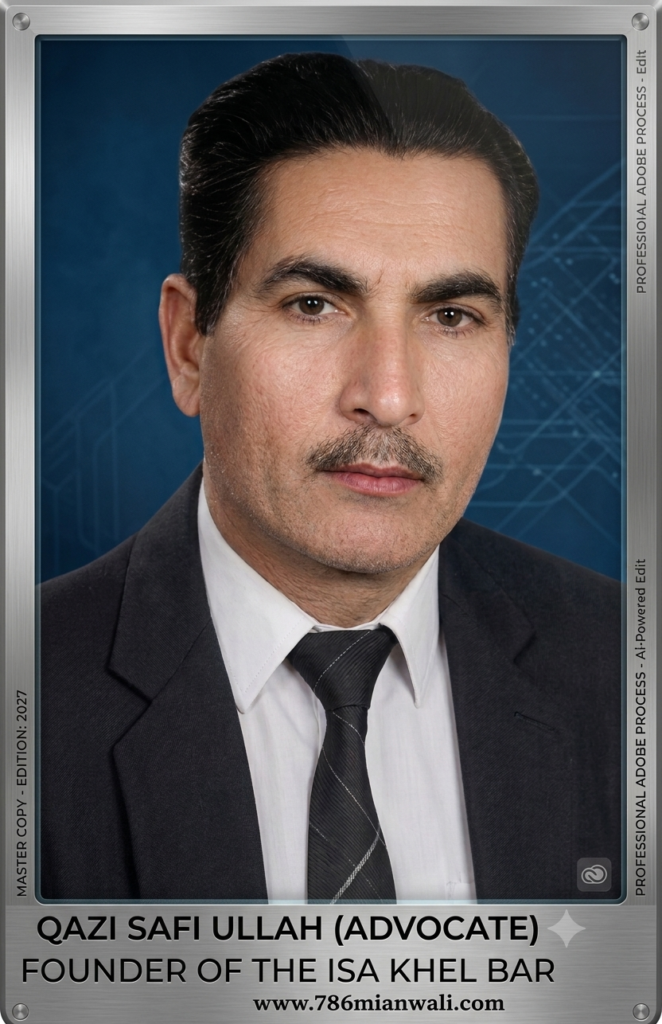
Qazi Safi Ullah
Advocate
Founder of the Isa Khel Bar Association
The family story begins with Qazi Safi Ullah, whose name is preserved
in the supplied historical archive as the founder of the organized legal
fraternity of Isa Khel.
His place in this record is both personal and institutional: he is remembered
as an advocate and as a figure associated with the establishment of a
professional legal institution that continued beyond his own generation.
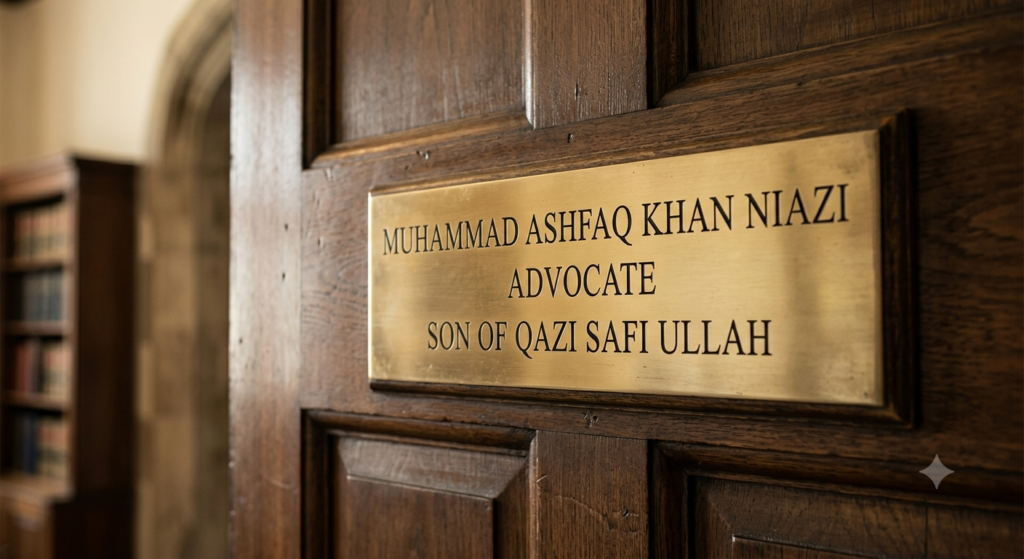
Muhammad Ashfaq Khan Niazi
Advocate
Son of Qazi Safi Ullah
The second generation represents continuity. Muhammad Ashfaq Khan Niazi
is identified in the supplied family record as the son of Qazi Safi Ullah
and as a later member of the legal fraternity of Isa Khel.
His place in the family record connects the pioneering generation with
the advocates who followed and preserved the family’s professional identity.
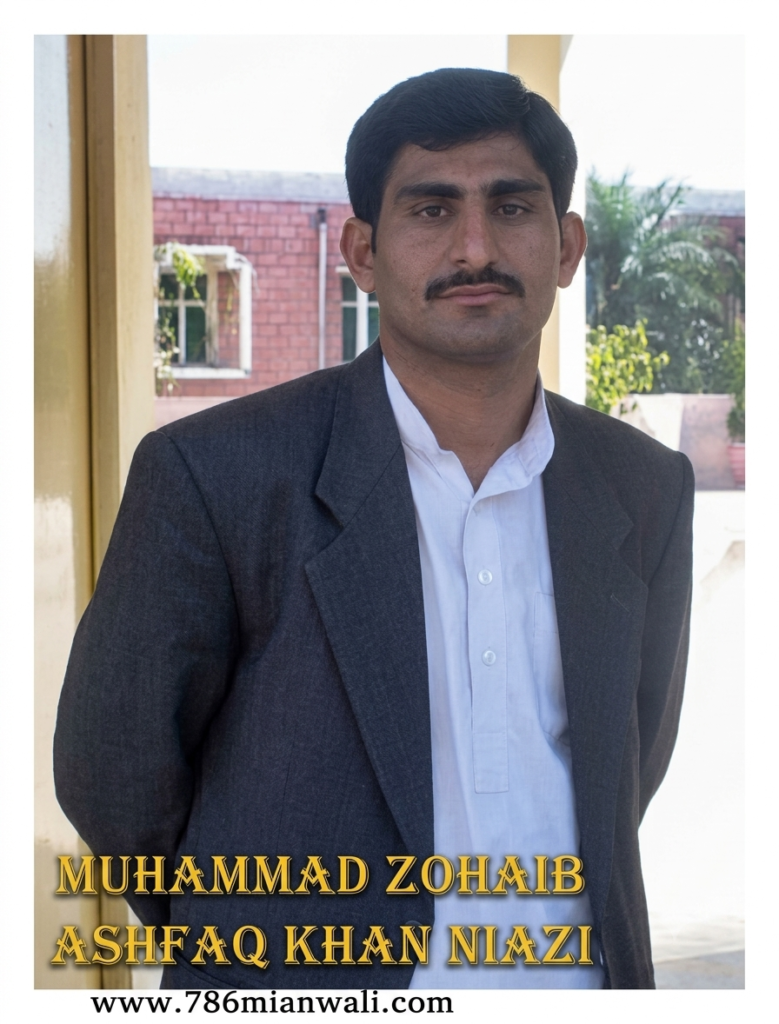
Muhammad Zohaib
Ashfaq Khan Niazi
Advocate
Grandson of Qazi Safi Ullah
Born on 29 December 1988, Muhammad Zohaib Ashfaq Khan Niazi represents
the third generation identified in the supplied family record.
His reported education includes Bachelor of Arts and Bachelor of Laws
degrees obtained in Quetta, Balochistan, connecting the family’s Isa Khel
roots with a wider Pakistani educational and legal tradition.
From Founder to Grandson
Qazi Safi Ullah
Founder · Isa Khel Bar Association
Muhammad Ashfaq Khan Niazi
Advocate · Son
Muhammad Zohaib Ashfaq Khan Niazi
Advocate · Grandson
A Tribute Across Three Generations
One generation established a foundation. The next carried the profession
forward. The third inherited the family memory and the responsibility
associated with continuing that tradition.
Together, these three figures provide a human dimension to the legal history
of Isa Khel: a founder, a successor, and a grandson representing the continuing
presence of the family within the legal life of the region.
Four Things That Endure
His Name
Qazi Safi Ullah remains identified in the supplied historical archive
with the founding of the Isa Khel Bar.
His Institution
The organized legal community of Isa Khel provides the institutional
setting through which his contribution is remembered.
His Tradition
Later generations of lawyers demonstrate the continuing importance of
legal practice within the community.
His Memory
This biography preserves the available record for descendants,
researchers, lawyers, and future generations of Isa Khel.
From Personal Memory to Public Heritage
The preservation of Qazi Safi Ullah’s story transforms a remembered
individual into part of the documented heritage of Isa Khel.
His story belongs within the larger history of Mianwali: the history of
courts, advocates, judges, litigants, families, educational institutions,
and civic figures whose work gradually shaped the public institutions
of the district.
Future archival discoveries may add dates, documents, photographs,
professional records, and personal testimony. Such additions should
strengthen the record without altering the distinction between documented
fact and historical inference.
Why We Preserve These Names
At Mianwali.org, we believe that the history of a district is not written
only through famous rulers, celebrated buildings, or major political events.
It is also written through the lives of ordinary and extraordinary people
who built its institutions and served its communities.
Qazi Safi Ullah Advocate belongs to that institutional history. His name,
his association with the Isa Khel Bar, and the family tradition preserved
around him deserve a permanent place in the historical memory of Mianwali.
We dedicate this record not merely to the past, but to the principle that
local history deserves the same seriousness, dignity, and preservation
given to larger national histories.
May this page remain a respectful record for his family, the legal community
of Isa Khel, researchers, students, and generations yet to come.
Preserve the Name.
Preserve the Evidence.
The purpose of this archive is not to make the past larger than the
evidence permits. It is to ensure that what has survived is not forgotten,
and that what remains uncertain is left open for future historians to discover.
The photographs reproduced in this memorial section are presented as
historical family images. Captions identify the individuals according
to the supplied family record. Original photographs should be retained
in the Mianwali.org archive in their highest available resolution.
اللہ تعالیٰ قاضی صفی اللہ ایڈووکیٹ کی مغفرت فرمائے،
ان کے درجات بلند فرمائے،
ان کی نیک خدمات کو قبول فرمائے،
اور ان کے خاندان اور آنے والی نسلوں کو
علم، عدل اور خدمتِ خلق کی توفیق عطا فرمائے۔
آمین۔
May Allah forgive Qazi Safi Ullah, elevate his rank, accept whatever good
he contributed to his community, and grant his family and future generations
the ability to serve through knowledge, justice, and service to humanity.
Ameen.
إِنَّ اللَّهَ يَأْمُرُ بِالْعَدْلِ وَالإِحْسَانِ
“Indeed, Allah commands justice and excellence.”
Qur’an 16:90
Qazi Safi Ullah
Isa Khel · District Mianwali · Punjab


